Hematite Meaning: Healing Properties, Benefits, and Uses
If your mind is racing and your to-do list keeps growing, hematite might be the stone for you. The hematite meaning is all about grounding, protection, strength, and focus. It’s linked to the root chakra, and many people keep it close when they want to feel calm, steady, and back in their own body.
Pick one up, and you’ll feel the difference right away. It’s surprisingly heavy, cool to the touch, and quietly reassuring in your palm. After more than 18 years of working with gemstone beads, we’ve learned a thing or two about this stone. Below, we’ll share where its blood-red name comes from, what it means spiritually, how to tell real hematite from fakes, and tips from our own bead room.
Hematite is all about grounding: It stands for grounding, protection, strength, and focus, and it’s closely linked to the root chakra. Many people reach for it when they feel scattered or stressed.
Its name comes from a hidden red side: Polished hematite looks silver-black, but it leaves a red streak when scratched. That’s why the ancient Greeks named it after haima, the Greek word for “blood.”
Real hematite is heavy and barely magnetic: If a bead snaps hard to a magnet, it’s most likely man-made “magnetic hematite” (hematine), not the natural stone.
Keep it dry for long-lasting shine: Wipe it with a soft cloth, and skip soaking, salt water, and ultrasonic cleaners. Water and salt can dull the polish and wear away coated finishes.
It’s an easy stone to design with: Hematite is affordable, works with gold or silver, and pairs well with stones like black tourmaline, tiger’s eye, and carnelian. Use strong beading wire, since full strands get heavy fast.
Hematite at a Glance
Association
Details
Core Meaning
Grounding, protection, strength, focus
Chakras
Root (also the Earth Star)
Zodiac Signs
Aries and Aquarius (some sources add Capricorn)
Planets
Mars and Saturn
Element
Earth
Numerology
9
Birthstone
Not an official birthstone
Colors
Black, steel gray, silver gray, reddish brown
Streak
Red to reddish brown
Mohs Hardness
5.5 to 6.5
Chakra, zodiac, planet, element, and number links come from crystal tradition, not mineral science.
What Is Hematite?
Hematite is an iron oxide mineral (Fe2O3) that is about 70% iron by weight and the world's most important iron ore. It looks black or steel gray when polished, but it leaves a red streak, which is the best way to identify it.
That streak is the line a mineral leaves when you scrape it across a piece of unglazed porcelain. Hematite's red to reddish-brown streak surprises most people, since the stone itself looks so dark.
Hematite forms in many settings. It builds up in layered sedimentary rocks, grows from hot mineral fluids, and shows up in small amounts in volcanic rock. Huge deposits sit in the Lake Superior region of Minnesota and Michigan. Brazil, Australia, China, India, and South Africa also mine large amounts.
In the United States, most people say "HEE-muh-tite." You may also hear "HEM-uh-tite," which is more common in British English. Both are correct.
Where Does the Name Hematite Come From?
The name comes from the Greek word haima, which means "blood." The ancient Greeks called it haimatites, or "blood-like stone." The name points to its red powder, not its dark surface.
Hematite has one of the longest human histories of any mineral. Ground into red ochre, it colored cave paintings, pottery, and Stone Age burials around the world, tens of thousands of years ago.
Here is how later cultures used it:
Mesopotamia: Carvers in ancient Babylonia turned hematite into cylinder seals and small charms. Much later, the Roman writer Pliny noted a Babylonian author who claimed hematite helped people win lawsuits and petitions to kings.
Ancient Egypt: Hematite was shaped into small amulets placed with the dead. Many were carved as tiny headrests, meant to protect the head in the afterlife.
Ancient Greece: In popular lore, hematite is linked to Ares, the Greek god of war. Warriors are said to have rubbed its red powder on their skin for courage before battle.
Rome: Pliny the Elder described several kinds of hematite and the folk remedies linked to each. Romans also carved it into signet rings and intaglios.
Medieval Europe: Stonecutters noticed that the water used to grind hematite turns red, so it was said to "bleed." People wore it as a protective charm.
There is even a link to space. NASA picked the Opportunity rover's landing site because orbiting spacecraft had spotted gray hematite there. In 2004, the rover confirmed it in tiny spheres nicknamed "blueberries," which scientists saw as a sign that water once flowed on Mars. It is a fitting story for a stone long tied to Mars, the Roman god of war.
What Does Hematite Symbolize?
Hematite symbolizes grounding, protection, strength, and focus. Its iron content and blood-red powder made it a sign of courage and life force for thousands of years.
Grounding: It pulls scattered energy back into your body and the present moment.
Protection: It is seen as a shield that helps you hold firm boundaries.
Strength: It reminds you that you are tougher than you feel on a hard day.
Focus: It is linked to clear, practical thinking and steady action.
We like how the stone itself tells the story. The shiny surface stands for the calm face you show the world. The red streak underneath stands for the warmth and courage you carry inside. Put simply, hematite stands for quiet strength that keeps you anchored.
What Is the Spiritual Meaning of Hematite?
Spiritually, hematite is an anchor. Crystal practitioners use it to come back into the body after meditation, set firm boundaries, and turn big ideas into practical action.
Many people hold hematite at the end of meditation or energy work because it is said to bring them gently back to the here and now. Some describe it as a bridge between spiritual ideas and real, everyday steps.
Crystal books most often list these spiritual properties:
Energy protection: It is believed to deflect negative energy and absorb tension around you.
Honesty: It encourages you to face what is bothering you, take responsibility, and move forward.
Yin and yang balance: It is said to balance receptive (inner) and projective (outer) energy.
Courage and willpower: It is linked to self-confidence and the drive to keep going.
EMF shielding: Some people keep it near phones and laptops as a symbolic shield.
Crystal writers such as Melody, in Love Is in the Earth, call hematite "a stone for the mind." Keep in mind that these ideas come from crystal practice and folklore, and science has not tested or confirmed them. Still, many people find the stone a helpful reminder to slow down and refocus.
A Simple Hematite Grounding Practice
You do not need any special tools to try this. Here is a short practice we like:
1. Sit in a chair with both feet flat on the floor.
2. Hold a piece of hematite in your palm and notice its cool weight.
3. Breathe in slowly for four counts, then out for six.
4. Picture your stress draining down through your feet into the ground.
5. After a few minutes, set the stone down and notice how you feel.
Even two or three minutes can help you reset on a busy day.
What Are the Healing Properties of Hematite?
In crystal tradition, hematite is believed to calm worry, steady the mood, and sharpen focus. Please treat these as traditional beliefs, not medical claims. Crystals should never replace care from a licensed health professional.
Emotional Healing
Hematite is believed to ease worry and lift heavy moods. Many people turn to it when they feel overwhelmed or drained by others. Some crystal writers say it nudges you to check your basic needs first: Have you eaten? Slept? Moved your body? You can also explore our guide to crystals for anxiety.
Mental Healing
It is said to sharpen concentration, memory, and logical thinking. Students, writers, and anyone working in a noisy space often keep it nearby.
Physical Traditions
Because of its link to blood, early healers tied hematite to blood, circulation, and recovery. Pliny wrote about it for wounds and eye problems. These are historical folk beliefs, and there is no scientific proof that wearing hematite treats any condition.
In short, hematite works best as a mindfulness tool. Its cool weight in your hand can be a simple cue to breathe and reset.
What Are the Benefits of Hematite?
The main benefits of hematite are practical: it is affordable, durable enough for daily wear with some care, and easy to style. Many people also wear it as a quiet confidence boost before a big moment.
Before a big moment: Many people wear it to a job interview, an exam, or a hard conversation.
Easy on the budget: It is one of the most affordable natural stones, so it is a great place to start a collection.
Unisex style: Its sleek, dark shine suits minimalist and neutral looks, which is why it is a favorite in men's bracelets.
Pairs with anything: Its metallic gray works with gold, silver, and almost any gemstone color.
Is hematite better for men or women? The meaning is the same for everyone. Wear it in whatever style feels like you.
Hematite Ring Meaning
A hematite ring is a popular symbol of protection, focus, and grounded confidence. Since you see your hands all day, a ring makes a constant, gentle reminder. Just treat solid hematite rings with care. They can crack if you knock them against a hard surface, and they cannot be resized like metal bands.
What Chakra and Zodiac Sign Is Hematite?
Hematite is linked mainly to the root chakra. It is most often paired with Aries and Aquarius, and with the planets Mars and Saturn.
Root Chakra
The root chakra sits at the base of the spine and governs safety, stability, and belonging. When it feels blocked, you may feel anxious or unsettled, and hematite is used to steady it. Some practitioners also connect hematite to the Earth Star chakra, a point said to sit below your feet.
Zodiac Signs
Hematite is most often paired with Aries and Aquarius. Fiery Aries gets calm, steady focus. Big-thinking Aquarius gets help coming back down to earth. Some crystal books also add Capricorn for its practical, disciplined nature.
Planets and Element
Hematite is tied to Mars for courage and drive, and to Saturn for structure and discipline. Its element is Earth, and its number in numerology is 9.
Since hematite is not an official birthstone, anyone can wear it, whatever their sign.
What Are the Different Types of Hematite?
The main types of hematite are specular hematite, kidney ore, iron rose, red ochre, and hematite mixed with other minerals, such as tiger iron. Polished hematite is usually black to steel gray, while earthy forms look reddish brown.
Specular hematite (specularite): Sparkly, mirror-like hematite made of tiny flat plates.
Kidney ore: Rounded, bubbly masses that look a bit like kidneys.
Iron rose: Flat hematite crystals arranged like the petals of a flower. Mineral collectors prize it.
Red ochre: Soft, earthy, powdery hematite used as pigment since prehistoric times.
Tiger iron: A banded mix of hematite, red jasper, and tiger's eye.
Hematite in quartz: Red flecks of hematite can help give strawberry quartz its pink to red color.
Coated or matte hematite: Gold, silver, rainbow, and copper finishes are surface coatings. Matte hematite has a soft, frosted look.
Each type carries the same grounding meaning. A trusted seller should always tell you if a finish is coated or treated.
Physical Properties of Hematite
These properties, based on data from Mindat, explain why hematite feels so heavy and needs gentle care.
Property
Details
Mineral Class
Oxide
Chemical Formula
Fe2O3 (iron oxide)
Crystal System
Trigonal
Mohs Hardness
5.5 to 6.5 (earthy red ochre is much softer)
Specific Gravity
About 5.3
Luster
Metallic to earthy
Streak
Red to reddish brown
Cleavage
None
Transparency
Opaque
Magnetism
Weak or none in natural stones
Is Hematite Magnetic?
Natural hematite is only weakly magnetic, and most pieces will not stick to a fridge magnet. Strongly magnetic beads sold as "magnetic hematite" are usually man-made.
These beads, sometimes called hematine, are typically made from ferrite, a man-made magnetic material. They are fine for design, but they are not natural hematite. If a bead snaps to a magnet, it should be labeled as man-made or magnetic.
Hematite vs. Look-Alike Stones
Several dark stones can be mistaken for hematite. A streak test sorts most of them out.
Stone
How It Differs
Streak
Hematite
Very heavy, metallic shine
Red to reddish brown
Magnetite
Strongly magnetic
Black
Obsidian
Volcanic glass, much lighter
White or none
Pyrite
Brassy gold color
Greenish black
Bloodstone
Green chalcedony with red spots
White
How Can You Tell If Hematite Is Real?
Real hematite feels very heavy, leaves a red streak, and barely reacts to a magnet. A strong snap to a magnet or a perfectly even rainbow finish usually means the bead is man-made or coated.
Feel the weight: Real hematite feels surprisingly heavy for its size. Glass and plastic feel light.
Try a magnet: A strong snap usually means man-made magnetic hematite.
Check the streak: A red to reddish-brown streak on unglazed porcelain is the classic test. It can scratch the stone, so skip it on finished jewelry.
Look at the finish: A perfectly even rainbow or gold shine is usually a coating.
Use these checks together rather than relying on just one. When you shop, choose sellers who clearly say if a stone is natural, coated, or man-made.
How Do You Use Hematite?
You can wear hematite, meditate with it, keep it at your desk, or design your own jewelry with it. Outside of jewelry, it is also one of the hardest-working minerals on Earth.
Industry: It is the main ore used to make iron and steel.
Pigment: As red ochre, it has been used for colored paint, pottery, and cave art for thousands of years.
Polishing: Fine hematite powder, called jeweler's rouge, is used to polish metal and glass.
In personal practice, here is how you can use it:
Wear it: Bracelets and necklaces keep the stone close all day.
Meditate with it: Hold one piece in each hand, or rest it near your feet, for a few slow breaths.
Keep it at your desk: It works as a quiet cue to refocus.
Carry a pocket stone: Smooth, cool hematite is perfect for a stressful moment.
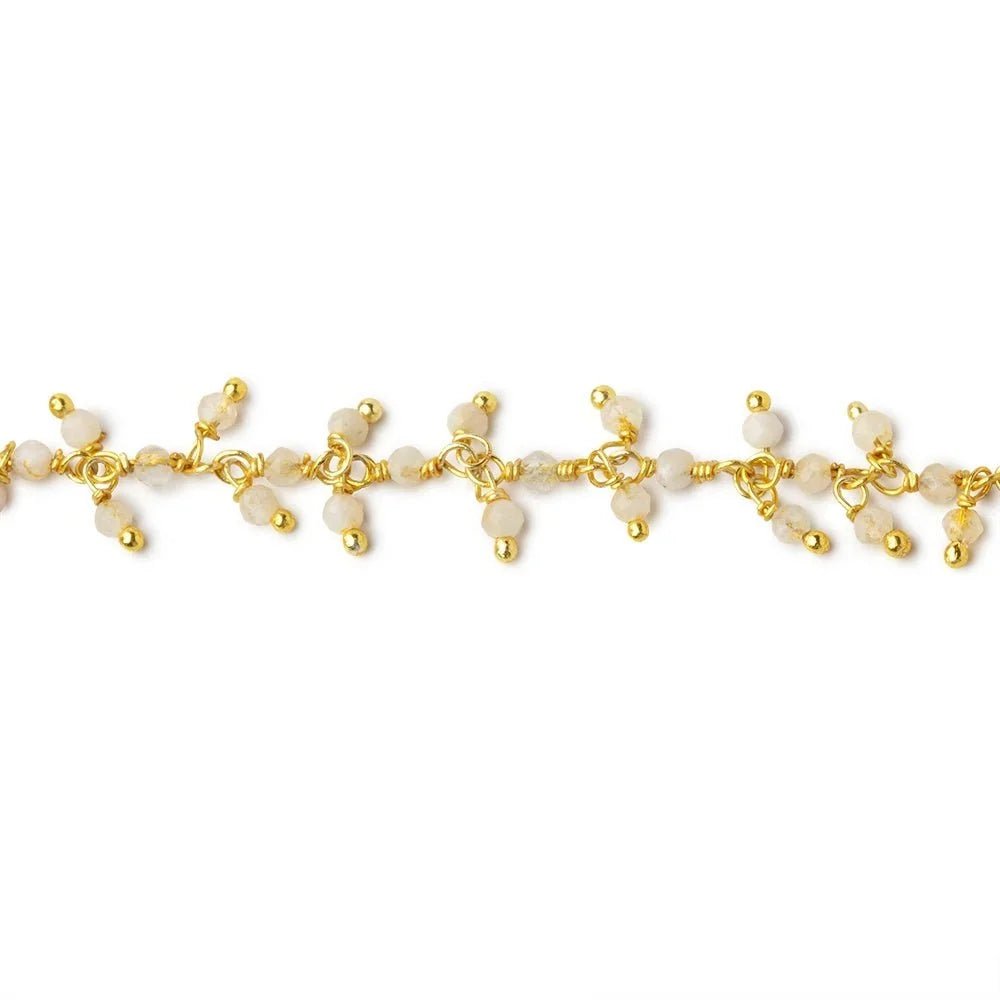
A tip from our bead room: Hematite is dense, so a full strand gets heavy fast. Use strong, flexible beading wire instead of thin thread, since bead holes can have hard edges that wear down silk or nylon over time. For a lighter feel, mix small hematite rounds with gemstones or metal spacers. Our hematite beads include micro-faceted heishi and rondelles as small as 2.3mm. We also offer faceted hematite on dangling chain by the foot in gold, silver-plated, and black gold finishes. That tiny metallic sparkle adds instant polish to any design.
How to Choose Hematite for Your Designs
Start with the look you want, then check the size and finish.
Natural polished hematite: Best for a classic black or steel-gray shine that goes with everything.
Matte hematite: A soft, frosted finish for modern, understated designs.
Coated hematite: Gold, silver, or rainbow finishes add color, but the coating can wear off on pieces that rub against skin or clothing every day.
Micro-faceted beads: Tiny 2mm to 3mm faceted beads catch the light like glitter and make great spacers.
Also check the bead size in millimeters, strand length, and hole size before you order. Small beads often have small holes, so match your wire or thread to the hole.
How Do You Clean Hematite?
Wipe hematite with a soft, dry cloth. Avoid soaking, salt water, steam, and ultrasonic cleaners. For energy cleansing, use dry methods such as smoke, sound, or selenite.
Hematite is already a form of iron oxide, so it will not rust like a nail. Still, water and salt can dull the polish, leave spots, and damage coated finishes, so keeping it dry is the safest choice.
Clean: Wipe it with a soft, dry cloth after wearing.
Avoid: Soaking, salt water, steam, ultrasonic cleaners, and harsh chemicals.
Store: Keep it in a soft pouch, away from harder stones that can scratch it.
Handle with care: Hematite can chip or crack if dropped on a hard floor.
Hematite is used for grounding, focus, and feeling protected during stress. In crystal tradition, people hold or wear it to calm racing thoughts. Jewelry makers also love it because it is affordable, shiny, and pairs with almost any stone or metal.
Is Hematite the Same As Bloodstone?
No, but the names have been mixed up for centuries. Today, bloodstone means green chalcedony with red spots. In older texts, though, hematite itself was sometimes called "bloodstone" because of its red powder. A streak test settles it: hematite leaves a red streak, and bloodstone leaves a white one.
Is Magnetic Hematite Real Hematite?
Usually not. Most strongly magnetic "hematite" beads are made from man-made ferrite and are sometimes sold as hematine. Natural hematite is only weakly magnetic. Magnetic beads are fine for design, but they should be labeled as man-made.
Who Should Not Wear Magnetic Hematite?
People with a pacemaker or another implanted medical device should ask their doctor first. Man-made magnetic hematite contains real magnets. Natural, non-magnetic hematite does not raise this concern.
Why Did My Hematite Bracelet Break?
Hematite is heavy and brittle, so a hard knock or thin thread can cause a break. Some crystal lovers believe it breaks after absorbing too much negative energy. Physically, restringing it on strong, flexible beading wire is the best fix.
Can Hematite Get Wet?
A quick splash is fine, but do not soak it. Water and salt can dull the polish, leave spots, and wear away coated finishes. Take it off before you shower, swim, or work out, and dry it with a soft cloth.
Which Wrist Should I Wear Hematite On?
In crystal tradition, the left wrist is for receiving energy and the right wrist is for releasing it. Many people wear hematite on the left to draw in calm, or on the right to let go of stress. There is no wrong choice, so wear it where it feels comfortable.
Can You Wear Hematite Every Day?
Yes, with some care. At 5.5 to 6.5 on the Mohs scale, it scratches and chips more easily than quartz. Store it away from harder gems, and take it off for workouts and cleaning.
Is Hematite Expensive?
No. Hematite is one of the most affordable natural stones. It is abundant worldwide. Price depends mostly on size, cut, finish, and whether the bead is natural, coated, or man-made.
Final Thoughts
The meaning of hematite has lasted for thousands of years because it is so simple. It is a reminder to slow down, feel your feet on the ground, and trust your own strength. Whether you wear it, hold it, or design with it, hematite keeps you anchored.
Ready to create? Explore our hematite beads collection at Beads of Cambay to find the right size and finish for your next piece. Pick the one that feels right in your hand.
Note: The information above is shared for cultural, historical, and educational interest. It is not medical advice or a substitute for professional care.
Arun Yadav is a distinguished expert in the gemstone industry, with over 18 years of experience honed through his family's legacy in sourcing and manufacturing beads. As the CEO of Beads Of Cambay, Arun combines his deep knowledge of the bead market with innovative strategies to lead the company to new heights. Arun's background includes previous roles at UPS and a BA in Business and Economics from Stony Brook University, equipping him with a robust skill set in E-Commerce, B2B sales, online marketing, brand development, and more.
Based in Lawrenceville, Arun is a prolific writer and thought leader, sharing his insights and experiences through engaging content that resonates with both industry professionals and consumers. His work not only sets new standards in the gemstone market but also inspires excellence and innovation.
To learn more about Arun Yadav's expertise and stay updated on his latest contributions to the gemstone market, connect with him on LinkedIn, and Facebook. His innovative approach and dedication make him a pivotal figure in the ongoing evolution of the bead and gemstone industry.